Coffee culture according to Caffè Hardy

Hardy culture

The millennia-old, remarkable story of coffee.

From legend to a journey lasting centuries, shaped by fortunate insights and hard work in harvesting, transport and processing the most remarkable bean in history.

The plant

One shrub,
a thousand worlds

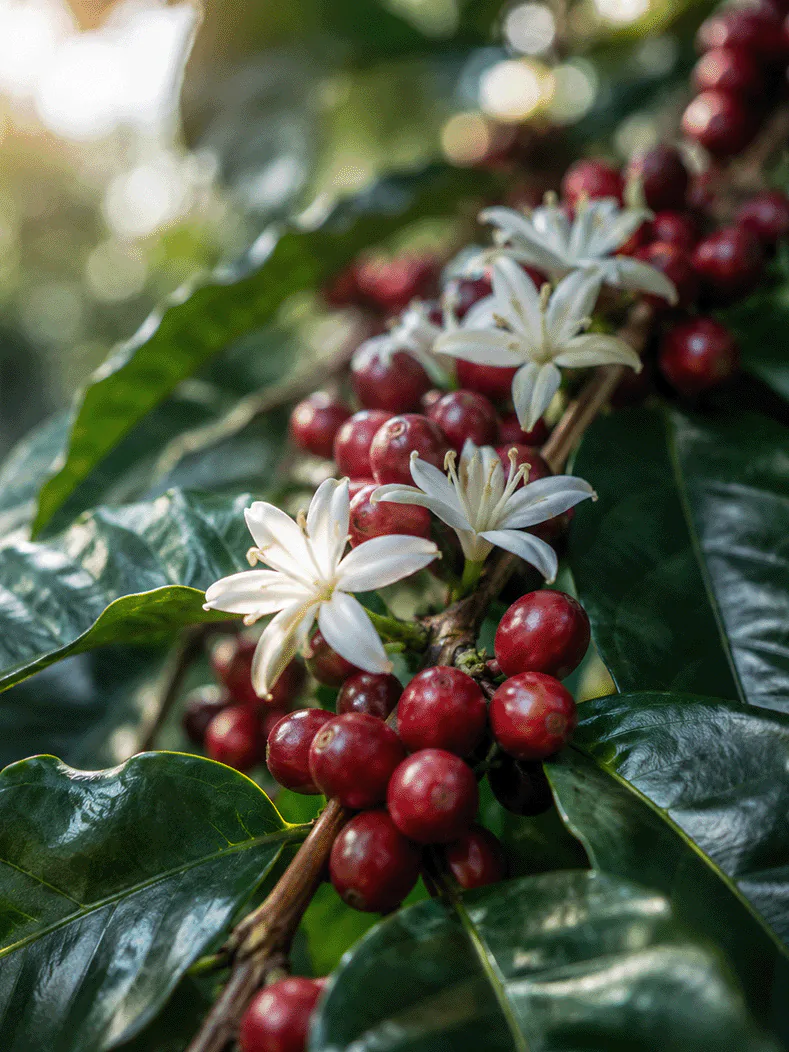
The coffee plant is an evergreen shrub of the Rubiaceae family, Coffea genus. Glossy green leaves, white jasmine-scented flowers, fruit — coffee cherries — ripening from green to deep red over nine months.

Inside each drupe are two beans, flat face to face. In rare cases a single round bean called peaberry forms: denser, more concentrated, particularly prized by connoisseurs for its aromatic intensity.

From flowering to harvest takes nine months. Slowness is part of coffee's character: nature cannot be rushed. Every bean carries the seasons, the soil and the care of those who grew it.

Red coffee drupes on the plant
«Coffee is the beverage of conviviality par excellence: wherever it arrived it brought awareness, conversation and culture»

Origins

Ethiopia, 9th century

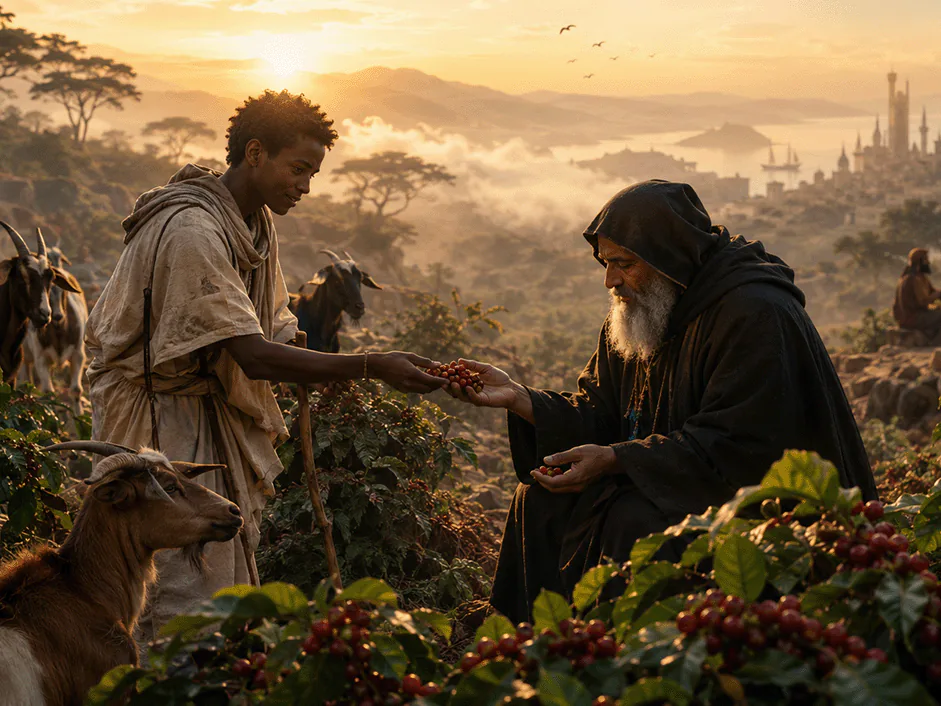
Kaldi presenting coffee drupes to a monk on the Ethiopian highlands

Legend tells of Kaldi, a young Ethiopian shepherd who in the 9th century noticed his goats unusually lively after eating unknown red berries. He brought the fruit to a monk, who made a drink and stayed awake all night in prayer.

Legend or history, the Kaffa highlands in Ethiopia are the cradle of coffee. The first documented use of coffee beans dates to the 15th century in Yemen, where Sufi monks in Mocha used coffee to sustain long meditation vigils.

From the Arabian peninsula, coffee took the name qahwa — a drink that excites the spirit. It was served in qahveh khaneh, coffee houses: meeting places for debate, music and poetry, forerunners of European cafés.

~ 9th century

The legend of Kaldi

Ethiopia, Kaffa highlands. First observations of the energising effects of wild coffee cherries.

15th century

Yemen and the Sufis

First documented use of coffee prepared as a beverage by Sufi monks in the Mocha region.

1475

Kiva Han, Constantinople

The first coffee house in history opens. Coffee becomes a social drink in the Ottoman Empire.

Spread

The journey to Europe

From the 15th to the 17th century coffee travelled Mediterranean trade routes and reached every corner of the known world. It brought something new: not just a flavour, but a way of being together.

01

The Arab world

Ottoman qahveh khaneh were centres of intellectual life where politics, philosophy and business were discussed. Sultans feared them enough to try banning them several times: they were considered too dangerous for the free thinking that flourished there.

02

Venice, 1683

Through its Mediterranean ports, Italy was the first European country to make coffee an everyday drink. Caffè Florian in Venice, founded in 1720, is the oldest in Europe still operating.

03

Enlightenment Europe

In the eighteenth century European coffee houses became salons of the Enlightenment. Café de Procope in Paris hosted Voltaire, Rousseau and Diderot. London counted three thousand coffee houses by the late seventeenth century: places where modern thought was shaped.

Istanbul, Bosphorus

Constantinople, 1475

«In coffee houses
modern civilisation was built»

For centuries, Ottoman qahveh khaneh and European coffee houses were where science, art and revolution were discussed. Coffee has always accompanied free thought.

Varieties

Arabica and Robusta:
two souls of coffee

The most prized

Arabica

Coffea arabica

Born in Ethiopia, it accounts for roughly 70% of world production and the entire premium segment. It grows at altitudes between 700 and 2,200 m, where slow temperature swings allow complex sugars and deep aromas to develop.

Caffeine
0.8–1.4%
Altitude
700–2,200 m
Profile
Sweet, floral, acidic
Origins
Ethiopia, Brazil, Colombia

The strongest

Robusta

Coffea canephora

Discovered in the Congo in the 19th century, it is named for its extraordinary resilience. It grows at low altitudes, ripens quickly and produces abundant, persistent crema — ideal for traditional Italian espresso.

Caffeine
1.7–3.5%
Altitude
0–900 m
Profile
Intense, earthy, full-bodied
Origins
Vietnam, India, Uganda

Geography

The Coffee Belt

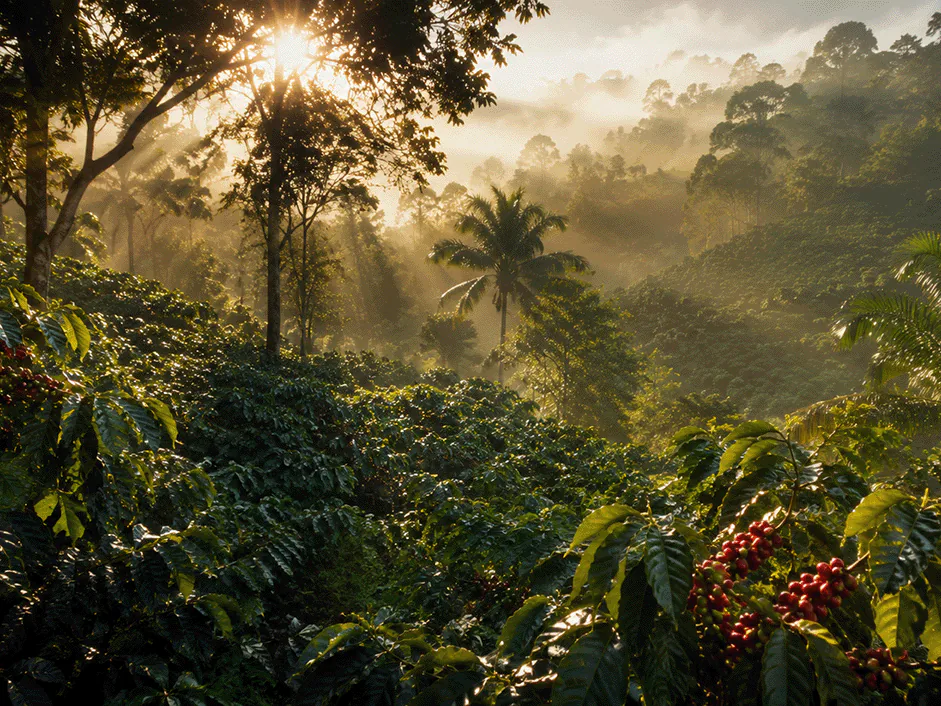
Coffee plantations among tropical hills at sunset

In the tropics
flavour is born

The Coffee Belt runs between the Tropic of Cancer and the Tropic of Capricorn: the only area on the planet where conditions are perfect for growing coffee.

Temperatures between 18 and 24°C, abundant evenly distributed rainfall, mineral-rich volcanic soils: every element helps create the aromatic complexity we find in the cup.

70+

producing countries

125M

people involved

2nd

global commodity

From plant to cup

Four moments, one ritual

Every cup is the result of a long, precise process where each stage shapes the final character of the drink. From hand-picking at high altitude to artisan roasting at the roastery.

01

Cultivation

The plant requires years of care before producing quality fruit. Stable production only begins between the third and fifth year. Altitude, microclimate and soil determine the character of each origin.

02

Harvest

Selective picking — by hand, only ripe red cherries — is the most prized method. Fruit ripens at different times on the same branch: mechanical harvesting cannot distinguish.

03

Processing

Washed or natural method radically changes aromatic profile: natural brings fruity and fermented notes, washed cleans and defines acidity. Green coffee is then exported to roasting ports.

04

Roasting

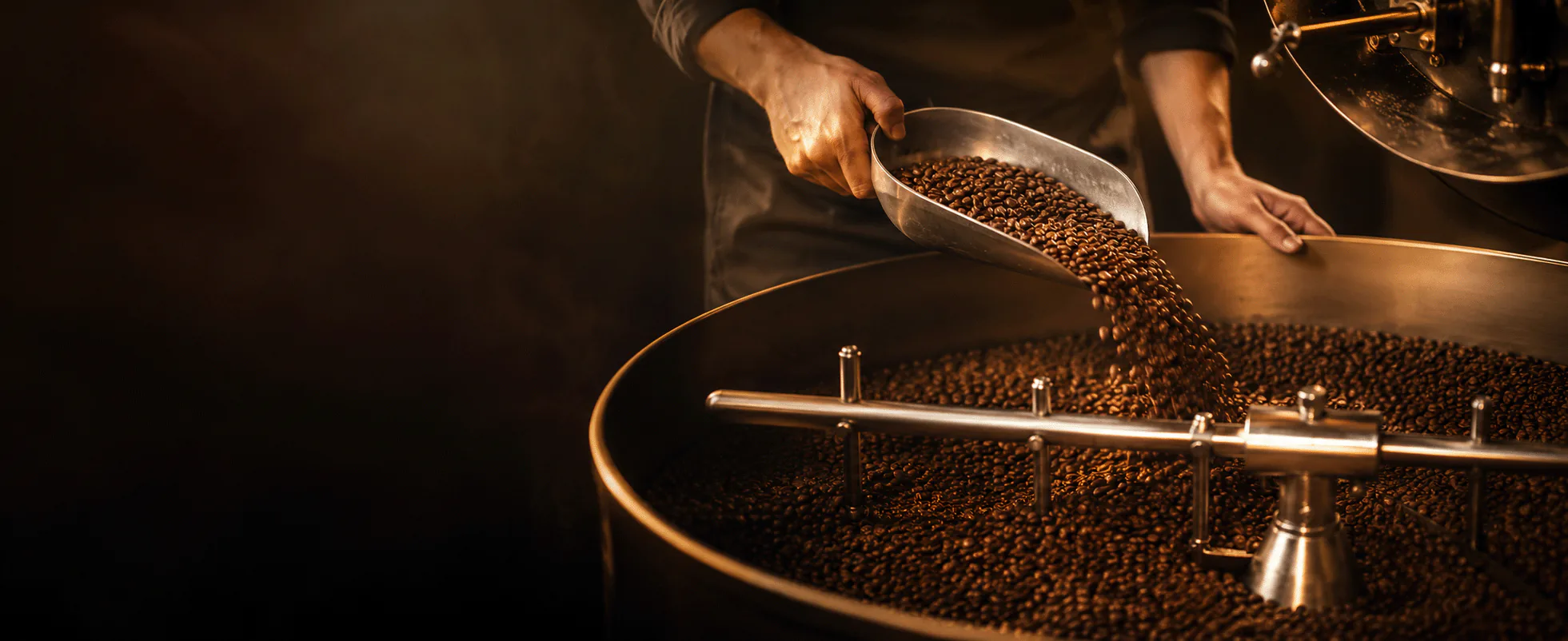
Roasting transforms raw material into flavour. Temperatures, times, roast curves: the roaster interprets the green bean and reveals its hidden potential.

Espresso cup on roasted coffee beans

Roasting

The art of turning
a bean into an emotion

During roasting the green bean undergoes over 800 chemical reactions. The Maillard reaction, sugar caramelisation, volatile acid development: every second counts, every degree transforms.

The Italian invention

The Espresso:
an Italian creation

In 1884 Angelo Moriondo patented the first steam coffee machine, but it was Luigi Bezzera in 1901 who developed the true espresso machine.

In 1948 Achille Gaggia revolutionised everything with the lever machine: 9 bar of pressure and the dense hazelnut-coloured crema that still defines the perfect Italian espresso.

The perfect espresso: 7 g of grind, 25–30 seconds extraction, 88–92°C temperature, 9 bar pressure. In those 25–30 ml is concentrated the entire chain's work, from plant to cup.

Espresso machine extracting coffee into a cup